

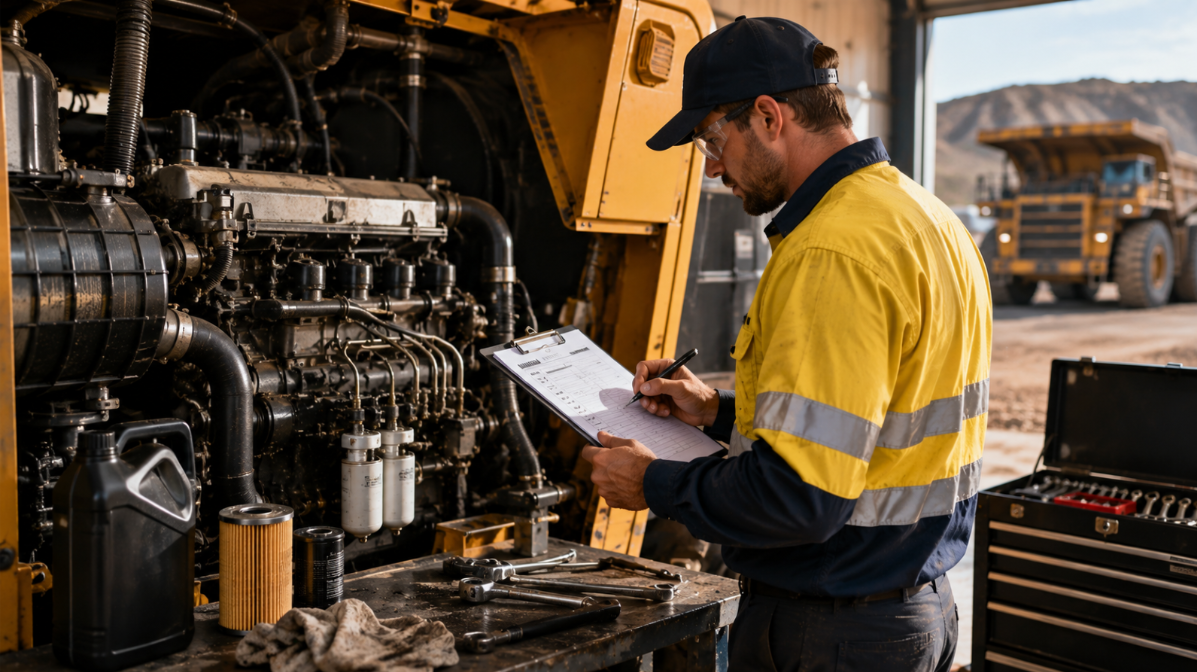
If you run diesel-powered machinery in Australia, unplanned downtime is one of the most expensive problems you can have. A missed service interval or an overlooked warning sign can turn into a blown engine, a stalled job site, or a truck sitting idle while on work.
Diesel Parts and Service has been working on diesel engines since 1970, and in that time we've seen firsthand how a proper maintenance schedule is the difference between a machine that runs for decades and one that lets you down when you need it most.
This guide breaks down what a sensible maintenance schedule looks like for diesel engines operating in Australian conditions, how often you should be servicing based on operating hours, and a practical checklist your maintenance team can use on the workshop floor. We'll also flag where genuine spare parts make a measurable difference to service life.
Why Diesel Engine Maintenance Gets Skipped (And Why That's Expensive)
Operations managers rarely skip servicing on purpose. It happens because machines are mid-job, technicians are stretched across sites, or a service interval gets pushed back "just this once" because the excavator is needed on-site by Friday.
The problem is that diesel engines don't fail gracefully. A neglected fuel filter doesn't just reduce performance - it lets contaminants through to injectors that cost thousands to replace. A coolant system left unchecked doesn't just run a bit hot - it warps a head or cracks a block. The failures that follow a missed service are almost always more expensive and slower to fix than the service itself would have been.
For fleet and plant managers across mining, agriculture, construction and transport, a diesel engine maintenance schedule isn't paperwork. It's the single biggest lever you have over unplanned downtime.
How Often Should You Service a Diesel Engine?
There's no single number that applies to every engine, application and operating environment - anyone who tells you otherwise hasn't run machinery in the Australian outback. That said, there's a widely accepted baseline that most manufacturers work from.
Manufacturers typically recommend a diesel service every 250 to 500 operating hours, though the exact figure depends on the equipment manufacturer's specific guidelines. This is the standard used across industrial diesel engines, and it's the interval confirmed by Deutz Australia for their industrial engine range - one of the more conservative and widely referenced benchmarks in the local market.
Where you land within that 250-500 hour range depends on a few real-world factors:
- Operating environment - dusty outback sites, coastal humidity and remote mine sites all shorten service intervals compared with controlled, indoor operation.
- Load and duty cycle - an engine running flat out on continuous duty wears differently to one doing light, intermittent work.
- Fuel and fluid quality - poor-quality diesel or inconsistent oil quality accelerates wear on injectors, filters and internals, which means more frequent attention is needed.
- Engine age and condition - older engines, or units nearing a major overhaul, generally need closer monitoring even if the hour interval hasn't been reached.
If you're unsure where your fleet sits, the manufacturer's handbook is the starting point - but it should be treated as a baseline you adjust for your actual operating conditions, not a number you follow blindly regardless of how hard the engine's being worked.
The Diesel Engine Maintenance Checklist
Below is a practical, workshop-ready checklist covering what should be inspected, serviced or replaced as part of a proper diesel engine service.
Engine Oil and Filtration
- Change engine oil at the manufacturer-specified interval (don't stretch it to "save" a service)
- Replace the oil filter at every oil change, no exceptions
- Check oil for contamination, discolouration or metal particles - this often flags a problem before it becomes serious
- Confirm oil grade matches OEM specification for your operating environment
Fuel System
- Replace primary and secondary fuel filters on schedule
- Drain water separators, particularly critical in humid or coastal regions
- Inspect fuel lines for cracking, chafing or leaks
- Test for fuel contamination - a common issue where diesel is stored on-site in bulk tanks
- Check injectors for wear or uneven spray pattern
Cooling System
- Check coolant level and top up as needed
- Inspect coolant condition and concentration - flush and replace per manufacturer schedule
- Inspect radiator, hoses and clamps for leaks, cracking or perishing
- Clear radiator fins of dust and debris - a genuine issue for machinery working in outback or agricultural dust
- Check the fan belt or drive for tension and wear
Air Intake System
- Inspect and clean or replace the air filter
- Check for restrictions in the intake system
- Inspect turbocharger for unusual noise, oil leaks or reduced boost
Belts, Hoses, and Drive Components
- Check belt tension and condition across all drive belts
- Inspect hoses for cracking, softness or leaks
- Check pulleys and tensioners for wear
Exhaust System
- Inspect for leaks or physical damage
- Check mounting points and hangers for corrosion or fatigue
- Confirm emissions components (DPF, EGR where fitted) are functioning correctly
Electrical System
- Check battery condition, charge, and terminal corrosion
- Inspect alternator output and wiring
- Test starter motor performance
General Inspection
- Check for oil, coolant, or fuel leaks around the engine bay
- Listen for abnormal noises - knocking, whining, or metallic sounds under load
- Record hour meter reading and log all work completed
- Compare current service against manufacturer's recommended interval for the next due date
Diesel Engine Maintenance Tips That Actually Make a Difference
Beyond the checklist itself, a few habits separate operations that get consistent uptime from those that don't.
Don't wait for the warning light. By the time a dash light comes on, the engine has usually already been running in a degraded state for some time. Scheduled servicing catches problems before they trip a sensor.
Match parts to the application, not just the part number. Using genuine or OEM-equivalent parts matters more in diesel engines than people expect - a cheap filter that lets particles through can undo months of otherwise good maintenance in a single fuel fill. If you're sourcing components for a service, our range of genuine diesel spare parts is built specifically around keeping industrial and commercial diesel engines running to manufacturer spec.
Factor in Australian conditions specifically. Dust ingestion, extreme heat, long distances between service points and variable fuel quality in regional areas all put more strain on an engine than the manufacturer's testing conditions typically assume. If your equipment operates in these conditions, it's worth servicing toward the lower end of that 250-500 hour range rather than the upper end.
Train the operators, not just the mechanics. Operators are the first line of defence - noticing a coolant smell, a new noise, or a drop in power well before it shows up on a service report. A quick daily walk-around costs nothing and catches problems early.
Don't let "it's still running fine" become your maintenance policy. Diesel engines are remarkably good at running fine right up until they're not. Consistent servicing on schedule, rather than reactive repairs when something fails, is what actually protects your uptime and your budget.
Building a Maintenance Schedule That Works for Your Fleet
A generic interval is a useful starting point, but the fleets with the least downtime are the ones that build a maintenance schedule around their actual machines, actual sites and actual operating hours - then hold themselves to it.
If you're managing a mixed fleet across multiple sites, that typically means:
- Logging operating hours per unit, not just calendar time
- Setting service triggers based on hours and operating conditions
- Keeping a parts inventory ready ahead of scheduled services, so a service doesn't get delayed waiting on a filter
- Reviewing service history regularly to catch patterns - a unit needing filters more often than its siblings is telling you something
We've put together a printable diesel engine maintenance checklist you can use it and hand straight to your maintenance team - get your copy below and keep it on hand for every service.
Need parts for your next scheduled service? Browse our full range of diesel spare parts for industrial, agricultural and commercial diesel engines, sourced to keep your fleet running to spec and on schedule.
